liberating what?
Untangling our broken ways of working with Liberating Structures
When we’re solving problems, we work together. We have meetings, we create planning documents and distribute them, we move post-it notes from one side of a wall to another, we talk during our breaks or at the coffee machine.
What if I told you that the way we work together is fundamentally broken?
Have you ever walked into a workgroup meeting and felt the energy draining from your body the very instant you entered the room? Did you ever experience a strategic presentation in which almost every attendant was busy on their phones? Is their laptop the most important thing people seem to bring to a conversation? Have you ever wondered why some people just never seem to speak up? Or why it’s always the same people that do all the talking?
It’s time to understand what happens and why it’s broken. It’s also time to fix this. Let’s work together, let’s include and engage everyone to allow the group’s true wisdom to surface. Let’s find the ideas and productivity that will never emerge when you’re working alone. Let’s explore Liberating Structures.
What’s happening?
Of course, we could say that the people using their phones or laptops are just rude. And the people that don’t speak up should just do so, right? That would be the easy thing to say. Does it change anything? No, it won’t. The people on their phones and laptops believe they are spending their time more productively than when contributing to the meeting they are in. The people that don’t speak up believe participating won’t make a difference. In other words: they don’t think this talk or meeting you’re in is of absolute importance, or at least that their contribution to it will not change the outcome.
What makes us think that?
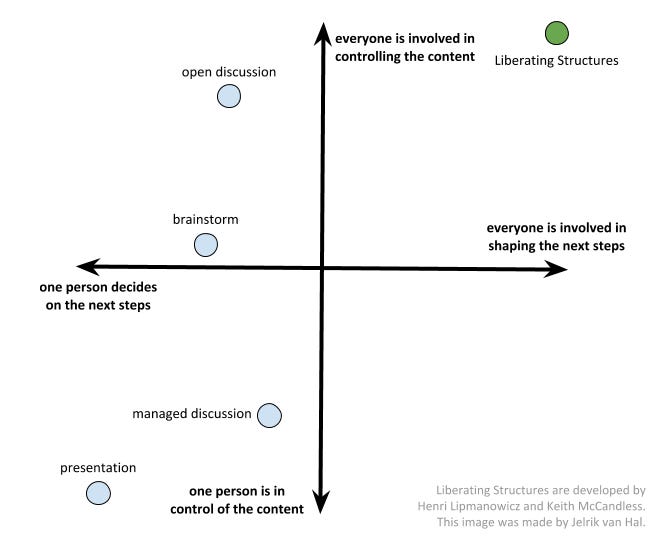
There are a few traditional patterns we use to organise ourselves to work with others. They are either heavily structured (as is the case with a presentation or a managed discussion) or lacking structure (open discussion, brainstorm). When a discussion is too structured, the amount and distribution of input from the group is limited actively by appointing a presenter or discussion leader that decides who gets to talk. When a discussion is too unstructured, it leaves the distribution of input from the participants up to good faith. This automatically leads to a few well-intentioned people to take the floor. Both sides of this equation result in frustration and the feeling of not being heard, not being productive, being disempowered and disengaged. In other words: participants will feel their contribution will not make a difference.
When we accept the premise that for an idea to flourish we need to view it from different perspectives, we need to discuss and dissect it, we need a crowd to believe in the idea, then there is just one conclusion we can draw: what we currently do is broken, we spend a lot of time working together in the wrong way.
The question, then, is how we can turn this ship around?
What’s happening under the hood?
To answer this question, we should dissect our traditional ways of working together into a diagram on two axis: the number of people in control of content vs the number of people involved in shaping next steps (see the figure included below). The number of people in control of content varies widely between the different traditional ways of working. The typical presentation, for example, leaves the content up to one or a few presenters, where the open discussion allows for everyone to try and take control of the content. However, most of the traditional ways we work together fail to include more than a few people in shaping the future. It’s always that couple of vocal people who, with the best of intentions, speak, but thereby silence the less vocal part of the crowd.
Another issue that you will recognise is the sluggish speed with which organisations take decisions. A single person, a small group of people, or a working group comes up with a plan and then has to send it off to multiple others for permission or input. They’re then busy “gathering buy-in”, convincing people, and explaining the reasonings underlying the proposed next steps. A lot of time is spent in this overhead. Can’t we make this simpler, less frustrating, and less time-consuming?
Liberation with Liberating Structures
To begin working towards an organisation or group in which everyone is engaged and empowered, and where everyone is heard, we have a strong need for all minds to participate. To shape the future together, to give way to the strong ideas that emerge from individuals that work together at the top of their game, we need to tap into the wisdom of the crowd. On top of that, we want to get rid of the endless meetings, e-mail discussions, and political games to “get everyone on board”. We can make this a reality.
Liberating Structures offers us three tools that build on each other:
- A strong theoretical base that originated in complexity science; the meetings we’re fixing are probably trying to tackle some complex problem, after all.
- Ten liberating principles that we can use to grow our organisational culture into one that unleashes the creativity of everyone.
- 33 liberating structures (and more in development) that are clearly defined and ready to go, without any need for an expert facilitator.
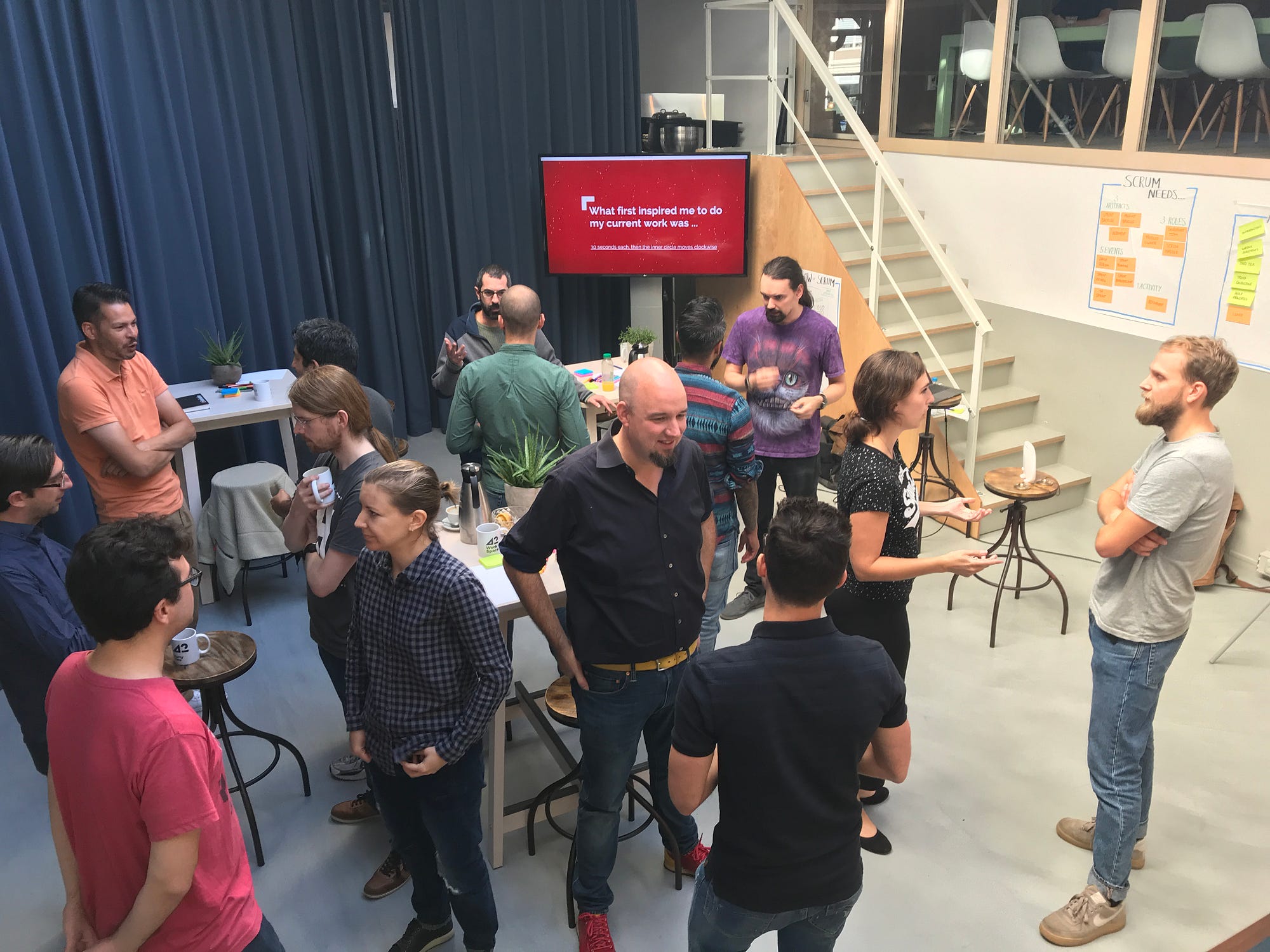
Ten liberating principles
Every interaction, change initiative, meeting, talk, session, or workshop can be shaped in terms of the liberating principles. The principles state beliefs about what is needed to grow towards a great and effective organisation to work in.
- Include and unleash everyone. When including everyone, both the people intricately familiar with the problem as the people that are empowered to support decisions on the solution, the notion of “gathering buy-in” and asking permission becomes obsolete.
- Practice deep respect for people and local solutions. The people closest to the fire are the ones that will likely come up with the most interesting solutions that are easily overlooked. Respect for local solutions, from the trenches, will foster creativity, and will bring to surface possibilities you never thought of before.
- Build trust as you go. Start small. Don’t try to change the whole company in one go, but ask for a very small commitment. For example, use one liberating structure and see how that goes. You and others will see that it works. Build from that small piece of trust and work to nurture it further.
- Learn by “failing forward”. When it doesn’t work, don’t panic. Learn from what happened and try again. Try not to go back to where you were before, but instead find a way to take another step.
- Practice self-discovery within a group. Let everyone discover problems and solutions. Don’t impose your ideas or let experts tell you how to solve a problem. Encourage experiments and let everyone learn from failure by experiencing it.
- Amplify freedom AND responsibility. Specify a bare minimum of constraints, and let go. Encourage tiny experiments and fast feedback cycles to increase learning. Enable the tracking of progress by all, instead of just a small group.
- Emphasise possibilities: believe before you see. Show what has worked well. What can be accomplished with the time and materials we have at hand?
- Invite creative destruction to enable innovation. What keeps everyone from doing their work? Discover what works against you and others, and don’t fear to strike that down. Welcome fears and failures as a way to learn what needs to change.
- Engage in “seriously playful” curiosity. Stir things up regularly: ask paradoxical questions, invite creative thought, and encourage our playful side to surface and help come up with solutions.
- Never start without a clear purpose. Dig to find what is important for you and others around you. Find the shared purpose you have with others. Take the time to know why you are working together in the first place.
33 liberating structures
Each of the 33 liberating structures (and the many more in development) has the power to change a meeting. When combined into strings of structures, they can change a company culture. The structures are open source and freely available from this website. Every liberating structure is extensively documented and described, in a ready-to-go fashion. For each structure, the website details five structural elements.
Structuring Invitation is without a doubt the single most important one. This part helps you understand what type of question to ask or what prompt to throw in, in short: how to invite participation from all? How Space Is Arranged and Materials Needed gives hints on how to make the room you’re in the most inviting for participation for a particular structure. Don’t let that giant meeting room table stand in the way of active contribution! How Participation Is Distributed and How Groups Are Configured help us understand how to make sure everyone can be involved and unleashed with a structure. Finally, Sequence of Steps and Time Allocation offers structure in the time-keeping sense, to prevent us from providing too little or too much structure that would hamper active participation by our participants.
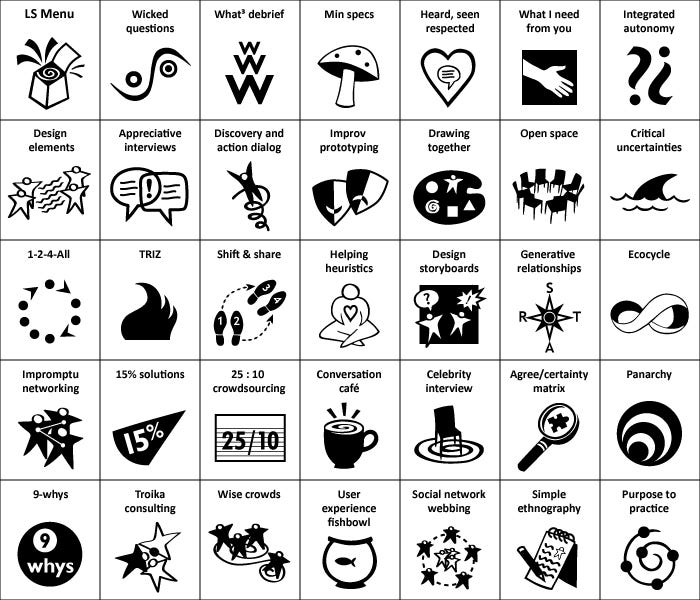
There is no need to have an expert around to liberate yourself and your organisation. Start with a simple one like 1–2–4-ALL, Impromptu Networking, or Nine Whys. Then, advance towards the more elaborate structures and string all of them together to get the best outcomes you’ve seen yet. Read through the structures on the website and their purpose and applicability. There are bound to be a few matching the purpose you’re after.
Just start!
Every single one of these structures are ready to use. The principles are there to inspire and guide you. They help you grow an organisation that is fun to be part of, because there are results to show for it. They include and unleash everyone and help you clarify the purpose of your work together, both cornerstones of effectively working together.
Say goodbye to the fundamentally broken way of communication we so dearly seem to hold on to.
Liberate yourself.